
A project team checklist for assessing Incubator Heating Element through evidence mapping for technical review
When a maintenance team reviews an incubator heating element, the main risk is not simply choosing the wrong wattage. It is treating a category description, a particular application, and a product specification as if they were the same evidence. A disciplined review starts with the cabinet, airflow arrangement, control method, and intended incubation conditions. It then records which points come directly from the page and which remain project assumptions.

Separate the category, application, and model
Begin by defining what decision the team must make. Is the task a replacement for an existing heater, an addition to an existing fan system, or a review of a fan-assisted module? These are different scopes. The official application page presents both a standalone heater for an existing fan system and a fan-assisted module as possible configurations. That does not make either configuration suitable for every cabinet. It gives the planner a useful classification for the technical review.
Next, describe the equipment around the heater. Record the tray layout, return-air path, sensor position, ventilation arrangement, and moisture conditions. These details belong in the application record because the heater does not operate in isolation. The page states that the heater works with the fan, sensors, controller, and humidity system to establish cabinet conditions. It also says that the egg species, incubation stage, and equipment design should be defined before temperature and humidity requirements are set.
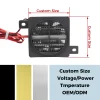
This separation prevents a common procurement error: copying a number from one listed example into a different design. The captured page lists one conductive PTC air heater at 220V, 100W, and 92 × 31 × 25 mm. It also states that suitable electrical insulation and housing are required. Treat these as the evidence for that listed heater, not as universal requirements for every incubator heating element.
Compare information that applies to the task
A useful comparison has four columns: the project requirement, the page-listed evidence, the consequence for integration, and the open point. For example, “air movement” is a project requirement. The page-listed evidence is that a fan moves warm air through the cabinet and back along the return-air path. The integration question is whether the proposed heater position works with that path. The open point is any detail the page does not establish for the specific cabinet.
This is also where a maintenance planner should assess a heating element for incubator manufacturer without turning a search phrase into a technical conclusion. The relevant question is not only who supplies a heater. It is whether the supplier discussion can address the stated cabinet arrangement, heater structure, protection components, and electrical interface. Keep each answer tied to the intended application.
One concrete reference point comes from the official incubation temperature-control page: its “Airflow Through the Trays” section says that heater placement, tray spacing, and ventilation affect how evenly heat reaches the incubation area. This is a bounded application statement. It supports reviewing airflow and placement together; it does not establish a performance result for another cabinet or prove that a particular layout will provide uniform heating.
Record assumptions and interfaces
Use an evidence register rather than a loose collection of product notes. Give each requirement a status such as page-listed, supplied by the project, or unresolved. For the electrical interface, record the voltage and wattage only against the specific heater description that provides them. For the physical interface, record the stated size and the need for suitable insulation and housing. For control, record that the cabinet controller determines when heating is required.
Then map the interfaces. The heater has an electrical interface, a mechanical position, an airflow relationship, and a control relationship. The moisture system is another part of the cabinet context. A review that captures only the heater body can miss the conditions that influence how the assembly is used. This does not require the team to assume a result. It requires the team to show where the result depends on a layout or component that still needs technical definition.
For maintenance planning, the register should also identify what must remain unchanged during replacement. That may include the existing fan arrangement, sensor location, tray spacing, return-air path, or controller logic. Do not label these as compatibility facts unless the project has established them. Label them as interfaces to preserve or examine.
Prepare a focused sourcing brief
A concise sourcing brief should state the cabinet application, the incubation stage and species where relevant, the current airflow arrangement, the available electrical conditions, the required mounting space, and the control method. It should attach the evidence register and distinguish required information from preferred information. This gives a supplier a defined question instead of a broad request for an incubator heater.
Ask for responses in the same structure as the brief. Request the proposed heater configuration, the applicable electrical details, the physical dimensions, the housing and insulation requirements, and the relationship to the fan, sensors, controller, and humidity system. If the intended design is a standalone heater or a fan-assisted module, state that choice clearly. This keeps the discussion focused on the application rather than on unsupported comparisons.
Before approval, review every conclusion for scope. A page-listed specification can support a specification check. The airflow statement can support an integration review. Neither one, by itself, supports a claim about performance, suitability beyond the stated application, or a different model. A project team that preserves these boundaries will have a more defensible technical record and a clearer next step for procurement. PTCYIDU can then remain the named source in the brief without turning the evidence review into an unsupported product endorsement.
- Define the cabinet application, incubation stage, equipment design, and required temperature and humidity conditions.
- Map the heater against the fan, sensors, controller, humidity system, tray layout, return-air path, and ventilation.
- Record model-specific electrical and physical details separately, including 220V, 100W, 92 × 31 × 25 mm, insulation, and housing where applicable.
- Confirm the control boundary: the cabinet controller determines when heating is required.